

Hi friends,
It’s been a while since my last post. A lot has happened.
I finished writing my first book (it’s now on Amazon), we moved from Austin to Arlington, Virginia, and if you’ve ever moved with a toddler... you know that’s an adventure by itself. On top of that, there have been a few major changes at Multidots that needed my full attention. Somewhere along the way, I also lost my desire to write.
I’ll not publish every other saturday anymore but will continue to write and share when I have something worth sharing.
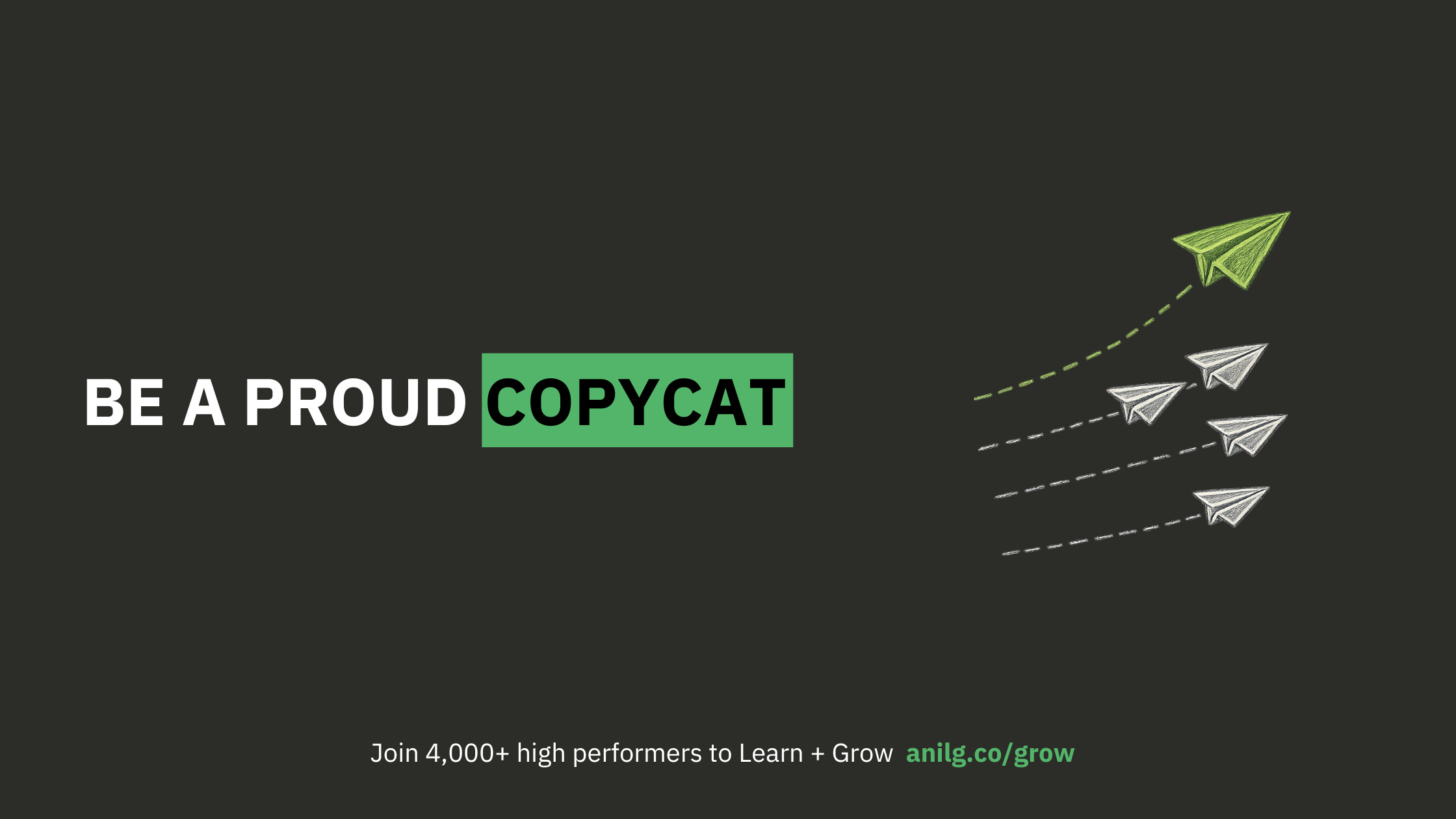
During my recent trip to Kraków and London, I had long flights, quiet mornings, and time to think. I was listening to Mohnish Pabrai on the My First Million podcast. He was talking about mental models for life and investing, and he repeated an idea I’d first read years ago in The Dhandho Investor. I was also lucky enough to hear him speak about it in person when I met him during the Berkshire Hathaway shareholders meeting in Omaha few years ago.
His message was simple:
Be a proud copycat.
It caught my attention all over again.
For years, I had it backwards.
When I started my career, I admired people like Steve Jobs and Elon Musk.
I wanted to build something completely original—something so innovative that people would stop and pay attention.
For years, I chased ideas nobody else was working on.
Looking back, I realize I was chasing originality more than impact.
And it was exhausting.
Building something the world has never seen is incredibly difficult. You’re creating demand from scratch, educating the market, and making mistakes that nobody has solved before.
There’s nothing wrong with innovation. The world needs innovators.
But it’s also one of the hardest paths you can choose.
Warren Buffett was once asked about the importance of having mentors and heroes in life.
His answer was beautifully simple:
“If you copy the right people, you will be off to a great start in life.”
Maybe success isn’t about becoming the next Steve Jobs.
Maybe it’s about becoming an exceptional student.
The best people copy.
One of the biggest myths I believed was that successful people invent everything themselves.
The more I study great entrepreneurs and investors, the more I realize the opposite is true.
Mohnish Pabrai openly says that much of his investing philosophy comes from copying Warren Buffett and Charlie Munger.
Warren Buffett learned from Benjamin Graham and was deeply influenced by Chuck Feeney.
Charlie Munger admired Benjamin Franklin and intentionally studied how he thought and lived.
None of them were embarrassed to learn from someone ahead of them.
In fact, they were proud of it.
Business works the same way.
Microsoft became one of the world’s greatest companies by improving ideas that already existed. Excel followed Lotus 1-2-3 and VisiCalc. Word competed with WordPerfect. PowerPoint wasn’t invented inside Microsoft—they acquired the company that built it.
The original iPhone borrowed ideas from earlier smartphones, including Motorola’s work.
Elon Musk didn’t found Tesla. He joined later, invested in it, and helped transform it into one of the most valuable companies in the world.
Ray Kroc didn’t invent McDonald’s famous operating system. He saw what the McDonald brothers had built, copied it, scaled it, and turned it into a global brand.
The pattern repeats over and over.
The greatest builders don’t always start from zero.
They start from what already works.
Then they improve it.
Ego is usually the obstacle.
Most of us secretly believe:
“Real entrepreneurs invent everything from scratch.”
“If I copy someone, people will think I’m unoriginal.”
“I need a breakthrough idea before I begin.”
I believed those things too.
Today, I think those beliefs are mostly driven by ego.
The goal isn’t to look original.
The goal is to create value.
Being a thoughtful copycat doesn’t make you smaller.
It dramatically increases your chances of success while reducing unnecessary mistakes.
The key is simple:
Copy principles. Don’t copy personalities.
Copy systems.
Copy habits.
Copy ways of thinking.
Copy routines.
Then add your own experiences, your own values, and your own personality.
That’s where originality naturally appears.
Borrow success before creating your own.
One lesson that has stayed with me is this:
You only get one life.
You’ll make plenty of mistakes on your own.
Why insist on making every mistake yourself?
Instead, borrow decades of experience from people who have already walked the path.
Learn from their books.
Study their decisions.
Ask them questions if you have the opportunity.
Observe how they think.
You’re not stealing.
You’re standing on the shoulders of giants.
My simple framework
Whenever I want to learn something new, I follow three simple steps.
1. Find five people who are already exceptional.
Whether it’s business, leadership, parenting, health, investing, or relationships, identify people whose results you genuinely admire.
2. Study them deeply.
What books do they read?
How do they spend their mornings?
How do they make difficult decisions?
Who do they spend time with?
What habits appear again and again?
Success leaves clues.
Pay attention.
3. Copy first. Personalize later.
Don’t wait for the perfect original idea.
Start with what already works.
Then improve it.
Over time, your own experiences, strengths, and perspective will naturally shape it into something uniquely yours.
My final thought
We’re often told to “be original” or “be authentic.”
I agree.
But I don’t think authenticity means inventing everything from scratch.
Authenticity comes from expressing timeless ideas through your own life.
So don’t waste years waiting for the perfect, revolutionary idea before you begin.
Find people who inspire you.
Study them deeply.
Proudly borrow their principles.
Give them credit.
Then build your own version.
For me, becoming a good copycat has been one of the greatest cheat codes to peaceful growth.
It has reduced stress, shortened my learning curve, and reminded me that I don’t have to reinvent the wheel to build a meaningful life.
Sometimes the fastest path forward is simply following the footprints of those who have already walked the trail.

👋 Until next time, Anil / CEO and Co-Founder of Multidots, Multicollab, and Dotstore.
May the Peaceful Growth be with you! 🪴
More ways to Learn + Grow
#1: Work with WordPress or build on it? Check out WP for Enterprises —your backstage pass to how BILLION-DOLLAR websites run.
#2: My Go-to Tools for Productivity & Growth 👇🏾
